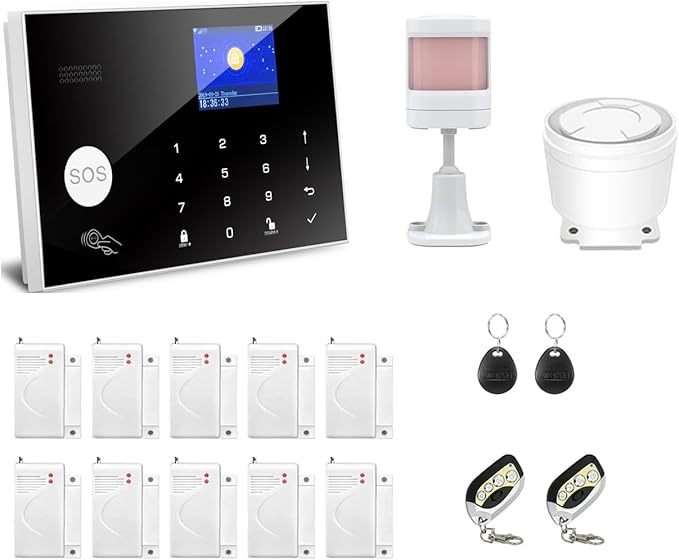
When looking for the ultimate way to protect your property, investing in a reliable WiFi + 4G GSM Smart Home Alarm System ensures you are never left vulnerable to power cuts or internet outages. Protecting what matters most should never depend on a single wire or an unstable internet connection. Traditional security setups often trap you in expensive, long-term contracts or fail the moment a storm knocks out your neighborhood internet. Modern home protection requires a smarter, more resilient blueprint.
A WiFi + 4G GSM Smart Home Alarm System bridges the gap between affordable DIY convenience and military-grade backup reliability. By blending high-speed wireless internet with a cellular fallback network, this type of system ensures your property remains monitored every second of the day, completely free of mandatory monthly subscriptions.
Whether you are looking to secure a suburban house, an urban apartment, or a remote vacation cabin, this deep dive explores how a dual-network ecosystem operates, integrates with major smart home platforms, and installs without a single drill bit.
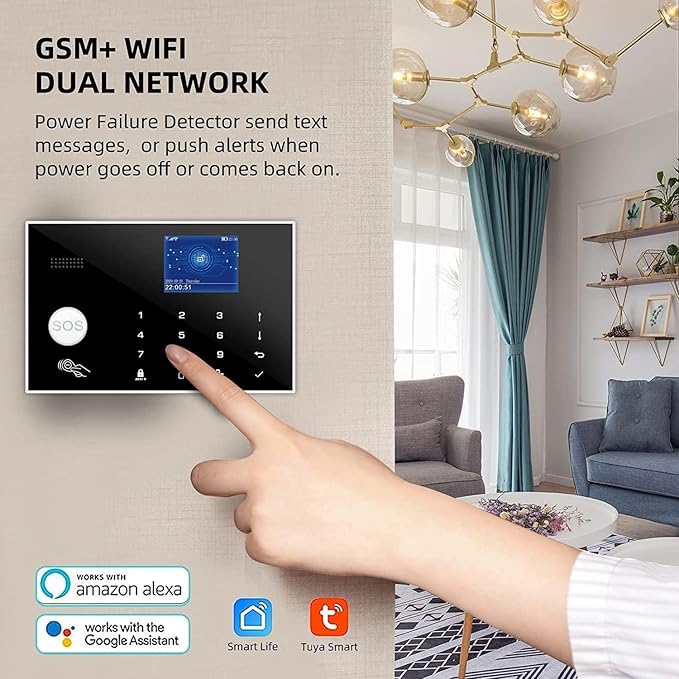
The Power of Dual-Network Redundancy
The main benefit of a WiFi + 4G GSM Smart Home Alarm System is its ability to automatically switch to cellular towers when your local internet service provider drops. The defining engineering characteristic of this security framework is its dual-network communication pipeline. Most entry-level smart home devices rely strictly on your home router. If a burglar cuts the power lines outside your house, or if your local internet service provider experiences an outage, those standard systems instantly go dark.
A dual-network system utilizes two distinct layers of defensive communication:
                  ┌──────────────────────────────┐
                  │      Smart Security Hub      │
                  └──────────────┬───────────────┘
                                 │
                ┌────────────────┴────────────────┐
                ▼                                 ▼
      Primary Path: WiFi               Backup Path: 4G GSM
  (High-Speed App Sync & Video)    (Cellular Calls, SMS, Fallback)
                │                                 │
                ▼                                 ▼
   Cloud / Smart Life Server              User Mobile Device
1. The Primary Layer: High-Speed WiFi
Under normal conditions, the main control hub routes all data through your 2.4 GHz local network. This connection handles instantaneous app notifications, sensor logs, and system state updates. Whenever a door opens or a motion sensor detects movement, the alert hits your smartphone via the cloud in milliseconds. This seamless transition between internet and cloud servers is what makes the WiFi + 4G GSM Smart Home Alarm System incredibly responsive during daily operations.
2. The Fail-Safe Layer: 4G GSM Cellular
If your local internet drops, the system instantly switches to its secondary path: a 4G GSM cellular module. By sliding a compatible SIM card into the master control panel, the WiFi + 4G GSM Smart Home Alarm System gains the independent capability to transmit data over nationwide cellular towers. Instead of a generic app notification that you might miss while sleeping, the panel uses the 4G GSM network to physically dial your mobile number or send direct SMS text alerts. You can program multiple emergency contacts into the hub, ensuring that if you do not answer the automated alert phone call, the system sequentially dials family members, neighbors, or property managers until someone acknowledges the alarm.
Inside the Core Hardware Ecosystem
A comprehensive smart alarm kit consists of a centralized command brain and a peripheral network of wireless sensors. These components talk to one another using secure, low-frequency radio waves (typically 433MHz or 868MHz). This localized frequency avoids standard network congestion and allows sensor batteries to last up to two years.
The Master Control Panel
The master control panel serves as the central brain of the WiFi + 4G GSM Smart Home Alarm System, coordinating all wireless sensors in milliseconds. The master panel functions as the core processing engine. Modern units feature a 2.4-inch color TFT liquid crystal display alongside a capacitive touch interface. Inside this compact unit sits a loud, integrated siren (usually rated around 100 decibels, which matches the sound level of a directional car horn) designed to disorient intruders and alert your immediate neighbors. The panel also contains a rechargeable lithium backup battery, keeping the entire sensor array powered and active for up to 30 hours during a complete blackout. Investing in a high-quality WiFi + 4G GSM Smart Home Alarm System means having a reliable hub equipped with a loud built-in siren and rechargeable backup battery.
Peripheral Detection Devices
To get the most out of your WiFi + 4G GSM Smart Home Alarm System, you can expand the kit with various accessories to cover every entry point of your building. An out-of-the-box security kit can be expanded to support up to 99 individual sensors, allowing you to scale the system as your space grows.
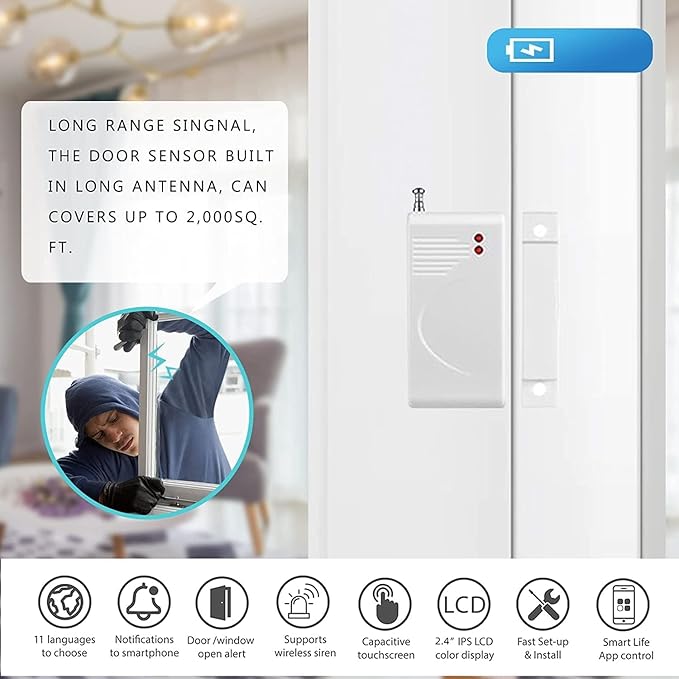
- Door and Window Contacts: These two-piece magnetic sensors monitor the entry thresholds of your building. Splitting the magnetic bond by cracking a window open instantly snaps the panel into an alarm state. As essential components of the WiFi + 4G GSM Smart Home Alarm System, Door and Window Contacts monitor the entry thresholds of your building.
- Passive Infrared (PIR) Motion Detectors: PIR sensors scan for changes in ambient infrared radiation caused by human body heat moving across a room. Premium variations feature specialized pet-immune lenses, ignoring moving animals under 15 kilograms (around 33 pounds) to prevent accidental false alarms.
- Remote Key Fobs & RFID Tags: Perfect for children or guests who do not have smart app access. Swiping an RFID token across the panel face instantly disarms the system as you walk through the door.
Universal App Control via Tuya and Smart Life
Managing your WiFi + 4G GSM Smart Home Alarm System is incredibly easy thanks to its native integration with the global Tuya and Smart Life applications. Rather than forcing you to use a proprietary, glitchy app, this system operates natively on the Tuya and Smart Life software ecosystems. These unified applications serve as the gold standard for global smart home integration, managing millions of connected devices across Android and iOS platforms.
Once you pair the system to your app via a simple QR code scan, you gain a dashboard to supervise your physical environment from anywhere in the world.
Customizable Defense Zones
Within the app interface, you can assign different behavior rules to specific rooms or access points. Setting up a WiFi + 4G GSM Smart Home Alarm System gives you complete flexibility over how your property is monitored throughout the day. Within the app interface, you can assign different behavior rules.
The system supports multiple arming postures:
- Away Arm Mode: Every sensor in the network is fully active. Use this when the house is entirely empty.
- Stay Arm Mode (Home Mode): Perimeter barriers like doors and ground-floor windows are actively monitored, but interior hallway motion detectors are temporarily bypassed. This allows you to walk to the kitchen at night without accidentally triggering a full siren response.
- 24-Hour Active Zones: Safety-critical peripherals like smoke detectors, carbon monoxide sensors, and flood indicators remain fully operational around the clock, even when the security system itself is completely disarmed.
Obfuscated Passwords and Tamper Protection
To prevent intruders from smashing the panel to silence it, the system features a rear-mounted mechanical anti-tamper switch. If someone attempts to rip the control panel off the wall, an immediate full-blast siren triggers alongside localized SMS emergency dispatches. Furthermore, the digital keypad supports obfuscated PIN entry. You can type up to eight random digits before or after your actual four-digit password, preventing onlookers from memorizing your unique code based on your finger movements. This multi-layered defense design ensures that your WiFi + 4G GSM Smart Home Alarm System remains safe from physical sabotage by tech-savvy intruders.
Smart Assistant Integrations
Connecting your WiFi + 4G GSM Smart Home Alarm System with Amazon Alexa or Google Assistant allows for hands-free voice control from anywhere in your house. Connecting your alarm system with Amazon Alexa or Google Assistant transforms your security hardware into an interactive, voice-controlled utility. This integration bridges your physical defenses with your daily routines.
Voice Commands for Arming and Disarming
Controlling your WiFi + 4G GSM Smart Home Alarm System is seamless because you can adjust your security status without reaching for a phone or stepping over to the master keypad. If you are tucked into bed and realize you forgot to secure the house, a direct phrase takes care of it:
“Alexa, arm the security system in stay mode.”
For safety reasons, disarming the system via voice commands requires an additional layer of verification. If you tell Google Assistant to disarm the alarm, the voice assistant will verbally request your secure four-digit vocal PIN. If an unauthorized individual tries to shout through an open window to disable your alarm, the system rejects the command without that matching numerical phrase.
Creating Home Automation Routines
Because the alarm panel interfaces natively with the Tuya platform, it can act as a trigger condition for your broader smart home environment. You can build automation chains inside the Alexa or Google Home applications to coordinate your appliances: Integrating your WiFi + 4G GSM Smart Home Alarm System into these smart routines eliminates the need to manually toggle your home appliances every time you leave.
- The Departure Routine: Setting the system to “Away” automatically shuts off all indoor smart plugs, lowers your smart thermostat to an eco-friendly temperature, turns off your interior lighting, and activates your standalone indoor security cameras.
- The Welcome Routine: Disarming the system upon your arrival instantly activates your entry lights, turns on your living room climate control, and switches indoor cameras over to physical privacy modes.
Step-by-Step Installation Guide
Setting up a modern WiFi + 4G GSM Smart Home Alarm System requires no professional tools or technical experience, making it perfect for renters and homeowners. Setting up this system requires no professional technical experience or proprietary wiring tools. The entire process uses zero-loss wireless frequencies and adhesive mounts, making it an excellent security choice for renters and homeowners alike.
- Power and Initialize the Master Hub
Duration: 5 Minutes
Plug the master panel into a central wall outlet using the provided power adapter. Turn on the internal backup battery switch located underneath the rear cover. Download the Smart Life app on your smartphone, create an account, select “Add Device,” and follow the prompts to sync the panel to your local 2.4 GHz WiFi network.- Configure the 4G GSM Backup SIM
Duration: 5 Minutes
Insert an active, unlocked nano-SIM card into the dedicated cellular slot on the panel. Ensure the SIM has PIN unlock disabled and contains a basic data, text, and voice call balance. Check the upper corner of the panel screen to confirm that a stable cellular signal strength icon appears.- Pair and Name Individual Wireless Sensors
Duration: 10 Minutes
Navigate to the accessories section within your smart phone app. Click “Add Sensor” and trigger the individual physical device (e.g., separate the door magnet or wave your hand in front of the motion sensor). Once the panel recognizes the unique radio signal, name the zone accurately (such as “Front Door” or “Living Room Window”) for clear notifications.- Mount the Hardware Elements Locationally
Duration: 15 Minutes
Clean your target surfaces thoroughly. Use the provided heavy-duty double-sided adhesive pads to mount the door contacts to your entryway frames. Ensure the spacing gap between the magnet and the sensor body is less than 10 millimeters when closed. Place motion sensors roughly 2 to 2.2 meters high on flat walls or corners facing inwards toward the center of your rooms.Comparing Smart Security Architectures
To help you decide how to map out your defensive framework, the table below highlights the operational trade-offs across common home security methods.
Functional Feature Standalone Local Alarms Standard WiFi-Only Systems WiFi + 4G GSM Dual Systems Upfront Cost Extremely Low Moderate Moderate Monthly Subscription Fees None ($0) Often Required for Cloud History None ($0) for Self-Monitoring Power Outage Protection Battery Operated Only Out of Service (No Router Power) 30-Hour Internal Hub Backup Internet Outage Protection N/A (No Web Features) System Disconnected Entirely Automatic Switch to 4G Network Smart Voice Control Impossible Supported (Alexa & Google) Fully Supported (Alexa & Google) Primary Alert Method Local Audio Siren Only Smartphone App Push Notification App Push + Direct Phone Calls & SMS Optimizing Long-Term Reliability
To ensure your home security system operates at its peak potential year after year, implement these minor maintenance checks every six months:
- Perform a Real-Time Signal Test: Walk to the furthest corners of your property and trigger the integrated SOS panic button on your key fob. Confirm that the central panel receives the signal instantly to verify structural radio penetration.
- Monitor App Battery Metrics: The Tuya interface proactively alerts you when any peripheral sensor drops below 20% power. Keep a small stash of CR2032 or CR123A batteries on hand so you can swap out low cells the moment you get a system push notification.
- Verify Cellular Credit Status: If you use a prepaid pay-as-you-go SIM card for your 4G GSM channel, set a personal calendar reminder to check the balance once or twice a year, ensuring it stays active for real-world emergency calling.
With a wireless, dual-network setup running through the smart ecosystem of your choice, you gain commercial-grade property protection without the burden of ongoing professional monitoring fees. It puts complete visibility, automation control, and ultimate peace of mind directly into the palm of your hand.
Choosing a prepaid SIM card for a DIY dual-network WiFi + 4G GSM Smart Home Alarm System requires a different strategy than picking a smartphone plan. Because the cellular connection acts strictly as a fallback network, the system will consume almost zero data or minutes unless your main home internet drops.
For an alarm system, you do not need an expensive “unlimited data” plan. Instead, you need a card that supports Voice (for auto-dialing), SMS (for text alerts), and a tiny amount of Data, built on low-cost maintenance rates.
The best prepaid SIM cards and data plans are divided below by network architecture and pricing structure.
1. Specialized IoT & Alarm SIMs (Best Value)
These specialized providers focus specifically on smart home hardware, M2M, and security frameworks to optimize the cellular channel of your WiFi + 4G GSM Smart Home Alarm System. These providers specialize specifically in smart home hardware, M2M (Machine-to-Machine), and security frameworks. They operate on a set-and-forget yearly or pay-as-you-go model.
- SpeedTalk Mobile (AlarmSIM) — Editor’s Pick
- The Network: T-Mobile / AT&T Towers (MVNO)
- The Price: Around $5 per month, or a pre-loaded $60–$100 annual card.
- What you get: 250 to 500 MB of data, plus 250 to 500 SMS text messages/voice minutes per month.
- Why it works: SpeedTalk is the market leader for Tuya/Smart Life panels. Their “Triple-Cut” SIMs fit the standard, micro, or nano slots on any generic hub. The annual pre-loaded options are ideal because you only pay once a year to keep your emergency backup line running.
- Things Mobile
- The Network: Multi-network roaming (automatically switches to the strongest local carrier, e.g., AT&T or T-Mobile).
- The Price: Pay-per-use rates starting at around $0.10 per MB.
- What you get: Pure consumption-based billing with no fixed monthly fees or card expiration dates.
- Why it works: If your home WiFi is incredibly stable and you only expect the 4G network to activate during rare power blackouts, a pay-as-you-go option ensures you only spend pennies a year when the system actually sends an alert.
2. Ultra-Low-Cost Mainstream MVNOs (Best Customer Support)
If you prefer dealing with traditional mobile virtual network operators (MVNOs) to power your WiFi + 4G GSM Smart Home Alarm System, these budget-friendly options stand out.
- Tello Mobile
- The Network: T-Mobile 4G LTE / 5G
- The Price: $5 to $6 per month.
- What you get: You can build a custom, flexible plan. For instance, $5/month gets you 1GB of data-only access, or you can mix 100 minutes of talk time with 500MB of data for a similar price.
- Why it works: Highly reliable, easily managed via a clean smartphone app, and lets you change or scale up your allocation instantly if you go away on an extended vacation and want extra text allocations.
- US Mobile
- The Network: Verizon (Warp 5G) or T-Mobile (Light Speed)
- The Price: $8 to $10 per month for light plans.
- What you get: Dedicated low-tier allotments featuring roughly 1GB of data, 250 minutes, and 250 texts.
- Why it works: Excellent if you live in a rural area where T-Mobile towers are weak but Verizon coverage is strong, allowing you to opt for their Verizon-based network architecture.
⚠️ Important Compatibility Checklist Before Buying
Before checking out with a prepaid SIM card for your WiFi + 4G GSM Smart Home Alarm System hub, verify these three technical requirements to ensure seamless remote alerts.
- Voice and SMS Capability: Ensure the plan you choose is NOT a “Data-Only” tablet/hotspot SIM. If your Tuya hub is programmed to physically call your phone number during an emergency, the SIM card must include a voice minute allotment.
- Turn Off the SIM PIN: Before sliding the new SIM card into your security master control panel, insert it into a standard smartphone first. Go to your phone’s security settings and disable the SIM PIN lock. If the card requires a PIN code to unlock upon booting, the home alarm panel will not be able to bypass the security wall and will show a “No Network” or “SIM Error.”
- Carrier Restrictions: Avoid strict contract carriers or major network mainlines (like post-paid Verizon or AT&T plans) that require complex device IMEI registration. Unlocked, non-contract MVNO cards work instantly without verification.
At DailyDealSpot24, our testing suite for 2026 involves more than just plugging in a dongle.